Sunday, 9 September 2012

Zombie Women of Satan - review


2009 (UK)

  
Contains spoilers.

Now you either get the juvenile, quirky, twisted and very British humour of Zombie Women of Satan with its ridiculous story, over the top characters, amateurish production and immature banter and effects or, like most the reviewers of IMDb etc, you don't.

Co-written, directed, produced, promoted by and starring Warren Speed as Pervo the clown, Zombie Women of Satan is a satirical exploration into the dehumanising effect of cult worship and a sociological study of morality and what people are willing to do and sacrifice in order to protect the ones they love. Or depending on how you look at it, it was an excuse to tell a story of a bunch of misfit burlesque performers fighting hordes of scantily clad zombies and tell as many knob gags and poo jokes as they could get away with. I'm leaning towards the latter.

Headed by the group's compère Johnny Dee Hellfire (Seymour Mace) the ragtag burlesque troupe and the heroes of our story, Flesharama are a motley assortment of miscreants. Johnny and Pervo are joined on and off stage by rock chick Skye Brannigan (Victoria Hopkins), Zeus the mighty and flatulent dwarf (Peter Bonner), burlesque dancer and ever vain Harmony Starr (Kate Soulsby), and mute chainsaw wielding giant Damage (Joe Nicholson).

Always desperate for publicity, Johnny Dee arranges an interview for the troupe with rising internet phenomenon Tycho Zander (Christian Steel) at his rural retreat where unbeknown to Flesharama, Tycho's father (Bill Fellows) and sisters have been conducting secret experiments to find a cure for their foul mouthed zombie-mother's (Kathy Paul) condition. Offering sanctuary, underwear and physical affection, Tycho has become a bit of a cult leader and has amassed quite the house full of scantily clad pretty girls for his father's literal disposal, and with the troupe's arrival the stage is too well set for something not to go seriously wrong.

Cue the action. A small oversight spreads the demon mother's disease to the girls and before anyone knows it the farm is swarming with dangerous snarling flesh hungry and rather feisty semi-naked zombie chicks. Flesharama find themselves in the centre of the maelstrom, not only fighting to survive but unexpectedly on a rescue mission after discovering Skye Brannigan's sister is being held after falling for Tycho's promises.

The battle for survival is over the top, ridiculous and delivers all the blood, banter, gags and boobs you'd expect to see from a film with 'Zombie Women' and 'Satan' in the title. Speed has crafted a character driven narrative with good confident pacing and uses an assortment of dramatic, shocking and comedy horror and action scenes to let the rich assortment of misfits shine. The mix of incredibly diverse and damaged personalities are allowed to interact with a surprising amount of depth and complexity, with entertaining witty and dare I say intelligently written dialogue throughout; the constant toilet-bowl jibing between Pervo and Johnny Dee is a particular highlight.

For a b-movie with a tight budget and limited resources the cinematography shows some real flare and vision and whilst the special effects, make-up and zombie splats are over the top and hammy it doesn't detract from the film, it adds to its charm. With the gags coming thick and fast Zombie Women of Satan knows what it is and never ever takes itself seriously.  I honestly don't know what people who heavily criticised the film thought they'd be getting especially considering the cover and title, but Speed set out to create a daft fantastical low budget zombie comedy and succeeded majestically. They wanted this to become a cult classic and whilst polarising opinion, I'm very much on the side that says Zombie Women of Satan achieves it, 7/10.

Steven@WTD.

Saturday, 8 September 2012

Fido - review


2006 (Canada)


Contains spoilers.

Well that was different... In an alternate 1950's small town America, life goes on as normal. Men go to work, women cook the dinner and wear nice dresses and children run and play, with zombies. After surviving the zombie wars, when the world was ravaged by interstellar radiation that brought the dead back to life, every day Americans have now, with the help of corporation overlords Zomcon returned to normality. Secure walls protect the towns from the savages of the wild lands and domestication collars have rendered the flesh hungry undead horde docile and subservient.

After Jonathan Bottoms (Henry Czerny) the new head of Zomcon security and his family moves in next door along with their six zombies, housewife Helen Robinson (Carrie-Anne Moss) keeping up with the Joneses buys a zombie of her own very much against the wishes of her husband Bill (Dylan Baker). Their son Timmy (K'Sun Ray), ostracized in school for always asking the wrong sort of questions soon builds up a rapport with the new house pet and names him 'Fido' before anyone else gets the chance.

Fido is played by a very subdued Billy Connolly who snarls and growls his way through the film with subtlety and character. With a permanently gormless expression and no vessel with which to throw his usual over the top personality his casting appears on the surface quite a strange one but it works and he makes the part his own. In fact for a film that I went into assuming a very b-movie amateurish polish, it's remarkably slick and professional with recognisable names throughout . Having never heard of the film I was surprised to read of its reasonably big budget, some $8 million, and a healthy list of production companies including Lions Gate. Somewhere along the way though it obviously lost the confidence of its backers as it was only shown in six screens in the US and netted just a sixteenth of its budget back worldwide, and for such a bold endeavour this seems both strange and a shame. You wonder if it had a big name such as say, Tim Burton, on the cover rather than director Andrew Currie whether its fortunes would have been different.

This is not your typical zombie film. As Fido, much like 'Bub' in George Romero's Day of the Dead, begins to display an increasing amount of affection and empathy towards Timmy, the film pokes and prods at notions of individual rights, pre and post death. In Willard (the town in the original 1968 Night of the Living Dead), once you're dead your body and what's left of your mind is there for the taking, for the right price. For all intents and purposes you forfeit all rights and become a slave to whatever purposes and abuses your new owner deems fit, and the only way to avoid this fate to plan ahead and start putting money aside for your funeral.

For a satirical thought provoking left field exploration of dehumanisation it still has it's fair share of blood and guts with the zombies primal desire for live human flesh bearing it's teeth from time to time in full techno-colour. Fido despite displaying restraint towards Timmy has an early encounter with a pompous elderly old lady who whilst in the process of giving him what for because she thinks he's trying to look up her skirt inadvertently knocks his restraining collar off. The subsequent mauling acts as a reminder that these really are bloodthirsty zombies and also as the strike of the first domino in a spiralling tale of death and lengths a young boy will go to to look after his unlikely friend.

Andrew Currie makes an effort to contrast the idyllic and perfect life in the town, with well tended gardens, polished cars and beautiful people all going on as if nothing was wrong with a savage and very real brutal wild outside. Over the fence it could very easily be the walking dead while inside is the 50's American sit-com in the suburbs; a tale of repressed emotions, alienation and maintaining the illusion.

Fido is a glorious highly stylised and thought provoking kitsch comedy. It's mainstream and deeply dark at the same time and true to the films that influenced it throughout. Billy Connolly has to be seen to be believed as the shambling Fido and builds a believable on screen friendship with Billy and Helen. It hasn't convinced me that we shouldn't shoot zombies in the head and ask question later but it's a fine attempt at exploring the personal rights of the dead in an apocalyptic scenario, and a well told look at the lengths people will go to, and the things they'll be prepared to ignore in order to maintain the facade and fit in. A funny, witty, vibrant dark comedy; you owe it to yourself, the people who produced it, and all the abused and neglected zombies in the world, to get a copy, 7/10.

Steven@WTD.

Friday, 7 September 2012

White Zombie - review


1932 (USA)

2010 included on Ultimate Horror Classics SD Blu-ray R(All)

Contains spoilers.

If George Romero's Night of the Living Dead is the granddaddy of zombie films then White Zombie, a 1932 American independent horror film directed and produced by brothers Victor Halperin and Edward Halperin, and regarded as the first feature length zombie movie must be the great-granddaddy. Whilst over the top story and extremely hammy acting certainly justifies much of the criticism this film has received, this Haitian tale of the dead being dug up and brought back as a mindless shambling undead is of great importance to the zombie aficionado.

On arriving in Haiti Madeleine Short Parker reunites with her fiancé Neil Parker (John Harron) and agree to take up the generous hospitality of wealthy plantation owner Charles Beaumont (Robert Frazer) who has not only agreed to host their wedding but has also offered Charles a future position as his agent in America. Unbeknown to Neil however, Charles has grown besotted with Madeleine on their sea journey to the island and is willing to do anything to secure her affections.

So Charles does what all good desperate over the top and hammy wealthy expats would and turns to local white English speaking voodoo master Murder Legendre played the inimitable Béla Lugosi and offers anything in return for help. Legendre gives Charles a poison and the offer to raise her from the grave where she will have forgotten Neil and will be his to worship and control.

After dying in Neil's arms during their wedding dinner, Neil turns to liquor and is haunted by ghostly visions of her. After discovering her body has been removed from her tomb, he calls on Dr. Bruner (Joseph Cawthorn), a missionary of thirty years who previously warned Neil to be wary of Charles, and who now offers an insight into what has really befallen Madeleine. Dr. Bruner explains that Neil's been hoodwinked; that Madeleine is more than likely still alive and that she was administered a drug that made her appear dead so that she could at a later time be revived by nefarious Legendre in his palace in the land of the Living Dead.

'With these zombie eyes he made her powerless and with this zombie grip he made her perform his every desire.' The zombies of White Zombie are always totally under the will of their voodoo master. Combining chemicals, mind control and voodoo magic Legendre has amassed an army of zombies which he uses to run his sugar mill and to provide personal protection. As with Romero's Dead trilogy, as well as horror from the narrative one can also see influence and echoes of the time the film was made. Produced during the Great Depression at a time of severe job shortages caused partly by the industrial revolution and automation started by Ford, the zombies of White Zombie can be seen to reflect the very real fear people had that not only were jobs being taken away through machinery and automation, but that workers were facing a future where they had no choice but to become mindless low paid production line slaves.

Whilst dead-eyed, mute and risen from the grave there's a real contention that the zombies of White Zombie aren't actually that dead, and therefore aren't really zombies. Revealed but not confirmed, the zombies of voodoo master Legendre have been raised from an induced catatonic state to an hypnotic one through a strange mix of voodoo magic and mind control. Arguably Madeleine's recovery after Legendre's demise attests this proposition, but it's not that straight forward. During the climax to the film, as Legendre commands his horde to attack Neil and Dr. Bruner, Neil clearly delivers what would normally be fatal shots to the attackers body to no effect. With the heady mix of hypnotic suggestion and magic this doesn't prove they're shambling undead corpses but it all adds to the ambiguity, and is clearly a magical moment where part of zombie mythology was born.

A quick mention of the Blu-ray compilation I picked this up on. Obviously using free out of copyright unmastered print, the presentation is ropey full of noise and bad sound. I've read that there are better DVD prints even ones including extras including interviews with Béla Lugosi but it's still very watchable and probably what I was expecting from a film from 1932.

White Zombie is an important film establishing much of the canon that others went on to follow and refine. The slow, shambling, dead-eyed creatures impervious to body shots, might never have been actually dead, but this film is too integral to the myth that I'm going to give them a free pass. Whilst the acting is not particularly good, the characters one dimensional and the plot a bit hammy and over the top, it's not actually that bad a film with a coherent plot and entertaining story. The cinematography and direction gives the film a melodramatic and eerie atmosphere, and watching some 80 years on one gets a real anthropologists look into a world now long gone. Still possessing a magic that will make the zombie connoisseur smile White Zombie is comprehensively recommended, 8/10.

Steven@WTD.

Thursday, 6 September 2012

[REC]² - review


2009 (Spain)


Contains spoilers.

Now I'm going to be a Debbie downer from the off. I enjoyed the first film, it wasn't perfect but it provided enough jumps and thrills to earn a solid 7/10 from me and left me eagerly anticipating this second outing. We'd been left with many unanswered questions and after a good debut thrill ride a sequel could only be better. So did it satiate my anticipation? In brief, no, not really. I kind of feel it was a hastily put together cash in with a hodgepodge plot thrown together at the last minute and an over-reliance on what it thought were the first film's key strengths. Ok, it's not all bad and directors and writers Jaume Balagueró and Paco Plaza obviously had a clear idea of where they wanted to take the franchise. The core narrative and direction is fine, it just could have benefited from more time and thought.

Following on immediately from [REC], [REC]² follows a small team of four special operations military types and Dr Owen (Jonathan Mellor), an official from the Ministry of Health as they enter the quarantined building to establish what the heck's been going on and gain control of the situation. Immediately being presented with lots of blood and the obvious signs that serious bad shit had gone down, the specialised and experienced unit ignore all their training and rather than establish control and work room to room they, under the instruction of Dr. Owen, make a bee line straight to the penthouse where he argues the source of the outbreak is.

With the roaming rabid zombies all taking a convenient five minute nap the team make it the top without incident where Dr Owen reveals his true identity, that of a Vatican priest and frontline religious problem solver sent to get a sample of blood from the Medeiros girl, help the old priest and save the world. Conveniently (I'll be using that word a lot) informing the team that they'll be isolated with no backup or external communication for the duration of their stay and that only he has the password to let them out, the rest of the film follows the priest and team stumble from one tense frenzied zombie encounter to another in an increasingly absurd, far fetched and implausible story.

A hallmark of [REC] was the shaky-cam-first-person perspective and Rec² is no different. Conveniently all the team are equipped with helmet-mounted video cameras but where-as for the most part Rec achieved a level of believability to why the camera was there and wasn't being turned off while all hell broke lose, in Rec² it felt a tad more forced, not necessarily from them having cameras turned on, but rather why their feeds weren't being transmitted to a control unit outside, and there was absolutely no back-up or central command.

Blood found, priest found, a world minutes away from salvation, and only thirty minutes in, a convenient complete you-can-see-this-coming-a-mile-away-so-why can't-they bungle sees our team and film back square one. The directors now obviously desperate for additional content throw some new victims, I mean characters, into the mix. A group of three teenagers, conveniently near by and conveniently curious,  team up with the father of little girl from the first film, conveniently convince a fire fighter to break the quarantine and let them in through a conveniently unguarded second entrance that's then conveniently welded up leaving them stranded with the rest.

And this is the crux of all my issues with the film; it's choc-stuffed with daft decisions obviously made to heighten tension and engineer horror scenes with high-impact and shock value, but it's all at the expense of retaining coherent narrative and maintaining authentic character behaviour. At some point someone forgot that the scares, the gore and the suspense were the tools that drove the story and characters of the first and not vice-versa. In [REC]² it's all turned around as they try and force the narrative to drive the shocks and scares. It doesn't work and feels mocked up throughout.

It's not all bad though. The zombie scenes are some of the most frantic and heart pumping I can remember. These are not slow rambling Romero zombies but savage, powerful and terrifying. The top tier special effects and closeness awarded from the first person perspective leads to genuine feeling of terror. [REC] worked in part because it was a character driven narrative and it's not surprising to see the [REC]² skimp in this area as well. You maybe didn't particularly like reporter Ángela Vidal (Manuela Velasco) in [REC] but you became invested in her character and as you followed her decent into fear the shocks and scares took on more substance. The soldiers and later teenagers of [REC]² are whilst well acted, unmemorable, one-sided and bland and any impact felt from their scares and inevitable mauling is reduced, as you realise you weren't invested in their characters from the start.

[REC]² is suspenseful, genuinely shocking, well filmed, solidly acted and has a good play with some interesting ideas, but it also suffers from unmemorable characters, an incoherent rambling unauthentic narrative full of cliché and more plot holes than a colander. It's not a bad film per se and if you like shocks at the expense of story it might work for you but as it is, and especially when put up against the original, a complete let down 4/10.

Steven@WTD.

Wednesday, 5 September 2012

Day of the Dead (1985) - review


1985 (USA)


Contains spoilers.

The 60's saw George A. Romero bring us Night of the Living Dead, the low budget breakthrough undead experience; oozing with vision and ideas, the granddaddy of the genre was very much a film of its time. Romero and Russo, whether intentionally or not, managed to capture and entwine all the prevalent societal prejudices and fears in a timeless horror narrative. Never forcing cold war politics or domestic racism in any obvious way they produced a film that works whether you acknowledge its subversion or not. 

The 70's saw Romero return with arguably the daddy of the zombie genre, Dawn of the Dead is the seminal apocalyptic masterpiece; a character survival story of small group doing all they can to stay alive against an abundant endless zombie horde. On the surface an action horror comedy Dawn of the Dead captures the same fears of the 1970's as Night of the Living Dead did of the 60's. With sweeping automation and a political agenda pushing rampant mindless consumerism, Dawn of the Dead took a satirical swipe at consumerism and yet does so with such subtlety the message could easily be lost under the weight of its strong narrative.

So to Day of the Dead, Romero's third instalment and this time a journey to the 1980's. In an era of Reagan and Thatcher, attention on military might and police and state control, it's no surprise to see the main focus of the film a power struggle between a group of scientists trying to understand and ultimately control the zombie virus and a military force, now confused and depleted trying to understand and control the scientists.

The apocalypse has purged life from the globe and the few survivors that are left are isolated and afraid. With a limited budget Romero returned to the tight claustrophobic feel of his first film to create a cooped up high pressure cinder keg , full of anxiety and paranoia where people become increasingly more desperate to take whatever measures they feel are necessary in order to survive. This time the disparate band have found themselves holed up in an old inadequate WW2 bunker in Florida, their military commander has just been killed and the group is increasingly becoming tense and at odds with each other.

Scientists Sarah (Lori Cardille) the only female survivor and Dr. Ted Fisher (John Amplas) under the guidance of senior eccentric Dr. Matthew Logan (Richard Liberty) are struggling with dwindling resources to provide tangible answers to the increasingly overbearing and hostile Captain Rhodes (Joseph Pilato) who's starting to question the sacrifices he and his team are making to keep the operation going.

With increasingly questionable methods and behaviour Logan, known as Frankenstein by the military, has moved from the search for a cure, sought by his colleagues, to a belief that the answer is to accept and manage their condition. This allows Romero to play with the zombie physiology and psychology in more depth than before. With special effects much closer to what these days we expect to see, Logan's lab and experimentation is a horrific abattoir of blood, intestines and severed heads with exposed organs and brains wired up at every turn.

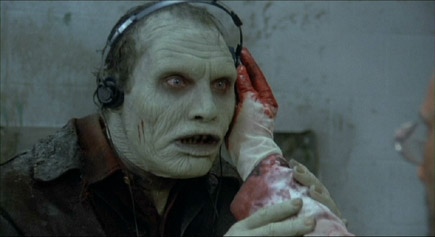
At first we learn via Logan, they don't require flesh for sustenance, (he removes stomach and all internal organs), that they decompose at slow rate and they're motivated purely by primal drives. Later he explores the idea that perhaps their old dead neural pathways could with help be reignited. Using what Rhodes and many of the others think is increasingly bizarre and later unethical methods he attempts to domesticate 'Bub', a specimen, he says with promise, by introducing objects and music that he hopes will stimulate his brain to reconnection old memories. Ultimately his hope is to demonstrate that zombies with help can be made docile and even useful, and all this will please Captain Rhodes and the military.

It's all fascinating stuff and is certainly something new to watch especially as Bub does indeed not only respond positively to the mad doctor, but later shows signs of reconnecting with his emotional self, clearly demonstrating sorrow and sadness and even a spark of vengeance. Ultimately though, and as in all good zombies films, things don't turn out exactly as hoped, the group splinters and disintegrates, chaos erupts, a lot of blood is spilled and Bub doesn't get to make a grand reintroduction back into civilised society.

Gone are the non-descript, signature blue and grey zombies of the first couple of films and perhaps parodying the militaries doctrine of desensitising soldiers to make them follow orders and work as a unit, the zombies of Day of the Dead show far more individualistic traits than before, with clowns, footballers, dancers, colour and outfits at every turn. Even the inclusion of Bub and the signs that he is possibly capable of redemption supports Romero's 80's subtext of retaining individual identity in the face of becoming merely a face in the crowd (horde). 

Well acted with a good mix of personalities I do feel the narrative suffers from characters that are a tad one dimensional throughout really only ever showing a single facet. The mad scientist, the relaxed Jamaican pilot, the alcoholic, the unquestioning always joking about soldiers; they never really display any real depth or complexity and this is most apparent with the megalomaniac racist misogynist Rhodes who throughout is almost too inhuman, desperate and evil to really come across as authentically plausible.

Day of the Dead is widely regarded as the weakest of the three Dead films and this is probably accurate. The characters are a little one dimensional and the narrative predictable, but it still offers a good tight zombie cinematic experience full of wit and intelligence. Romero's zombies still show why they're the benchmark 25 years on, and with improved special effect techniques, inside and out, Day of the Dead probably stands out as the pinnacle his legacy. The action and pacing is faultless and whilst I have I no real complaints, to me, it just never quite reaches the heights of his previous efforts, and if anything the storty is perhaps all a little safe and even dare I say occasionally mundane. A Romero zombie classic nonetheless, 8/10.

Steven@WTD.

Monday, 3 September 2012

Pontypool - review


2008 (Canada)


Contains mild spoilers.

More a psychological horror thriller than zombie film, Pontypool is a tightly focused drama that focuses on disgraced local small town disc jockey Grant Mazzy played by Stephen McHattie and his small team as they follow and broadcast the Canadian town's average winter morning, of school bus delays and traffic congestion, descend into chaos. Adapted from Tony Burgess' novel Pontypool Changes Everything, Pontypool is a philosophically ambitious attempt at something genuinely new and terrifying and whilst requiring a certain suspension of disbelief pulls off an entertaining yarn that certainly raises a few metaphysical questions.

Even early in their shift it becomes clear to the new morning anchor Mazzy, his producer Sydney Briar (Lisa Houle) and technical assistant  Laurel-Ann Drummond (Georgina Reilly) that the morning's usual routine is going to be anything but mundane and normal. Supping on his morning whiskey Mazzy responds initially by making fun of what he perceives to be a small town drunken hostage situation but as more reports file in, his old hunger and tenacity start to surface with a desire to connect the dots and find out what's really happening.

The dynamic between tired and brow-beat maverick and controversial Mazzy, reduced to finishing off his days as a small time radio DJ, and a confident but fragile divorcee producer Briar constantly keeping him in check is tried and tested but works. The acting is confident and whilst the characters are well portrayed, a lack of urgency and panic especially during some of the more intense latter scenes did dismantle some of the credulity a touch.

The slow safe build up soon ups the ante with weather and traffic helicopter reporter Ken Loney first calling in to talk of rioting citizens laying siege to a nearby local doctor's surgery and later of herds of mumbling, chanting, naked wild animal like citizens roaming the streets searching out survivors to tear and apart and eat.

It certainly sounds like a zombie film at this point, having the word zombie quoted on the cover, but it's clear from the outset that the victims are infected and not dead and resurrected. Always a good debate I'm a bit of a purist and although they're incoherent mindless monsters with a desire for live flesh, the fact that there's no surviving death and no head shots as a final solution, zombies for me they are not. Also while I'm always happy to broaden the definition of zombie to describe creatures exhibiting zombie like behaviour it's not quite good enough for me to call this a zombie film and I'd put Pontypool in the same category as The Crazies. Even director Bruce McDonald stressed the victims of the virus aren't zombies and he called them conversationalists.

What stands Pontypool apart from other infected-people-going -a-bit-loopy films like The Crazies is the nature and transmission of the virus. There's no chemical spill, lab breakout, or even evil darkness. Burgess has put forward the unique notion that the infection is spread through language, more specifically, through conversation and the transference of an idea. At the point of understanding, of knowing an infected-trigger word or phrase, the infection/virus/parasite pops into existence in the host. Philosophically the idea is fascinating; outside consciousness and language the infection doesn't exist but somehow as the infected-idea encapsulated by a key word or phrase is passed from infected to victim, the reality of it is also shared. Without the structure and bounds of language, consciousness and understanding it couldn't exist yet as the parasite or the idea of the infection isn't transferred but comes into reality when the idea is realised it must already be ever-present. It's certainly a play with the philosophy of language, consciousness and reality and depending on how you take it could just as well as being seen as a clever metaphysical, yet inherently terrifying, paradoxical conundrum, or as a right load of old tosh...

The film carries across its origins as a radio play and feels like a drama set almost exclusively in the few rooms of the radio station. Just like the station crew, the viewer is never granted shots of the world outside to confirm what is taking place and this restriction to the same information allows the same feelings of confusion and doubt to transfer. Really demonstrating what can be accomplished with a limited budget McDonald puts to shame many horror films that either fail with too much ambition or too much low grade special effect. It's a clever authentic tight little narrative and, despite the single set and small cast, moves with good pace and never becomes tiring.

Initially disappointed I'd picked another nearly-but-not-quite zombie film, I enjoyed Pontypool because of and despite of all it's existential tomfoolery. With a well presented narrative, established three dimensional characters and tight professional production that looks glorious in high definition there's a lot to recommend, but in some respects the very things that make the film a success also hold it back. As well as a lack of real action, the single scene environment restrains the narrative and any feeling that the problems could be really be apocalyptic in scale. Also it's never really that scary and whilst the scenes with the infected are well presented and shocking they are infrequent and let down by the survivors' subdued reaction to them. A tight slow paced psychological mind-fuck. Think of a number, got it? 7/10.

Steven@WTD.

Sunday, 2 September 2012

The Dead - review


2010 (UK)


Contains mild spoilers.

If there's one word that comes to mind watching The Ford brother's The Dead, it's bleak. Filmed in Burkina Faso, the directors paint a beautiful rich African canvas, full of dry tropical savannah and deep blue Pacific water, and contrast this with a foreground full of unremitting death and despair. There is no time to stop and admire the view as from start to finish The Dead offers a world where there is no respite, no hope and death is an inevitability.

The lone survivor of the last ill fated evacuation-flight, engineer Lt. Brian Murphy played by Rob Freeman finds himself stranded with few supplies on the coast of a West African overrun by the living dead. With no clear plan his only focus is to survive long enough to be reunited with his wife and daughter back home. It's focused on this task and travelling away from the coast in a ruined car he manages to fix up that he runs into Sgt. Daniel Dembele (Prince David Oseia) who comes to his rescue after he gets himself into a bit of a pickle.

Discovering that like him, Dembele is focused on reunited with his child, in this case his son, and realising that there is to be no quick escape from the country, the disparate pair agree to share the hundred mile journey north where they believe some safety and answers can be found. So what begins is harrowing tiring journey of survival and the focus of the film.

The zombies of The Dead follow the Romero tradition with the Ford brothers playing very safely with established zombie rules and canon. They're slow shambling  mindless monsters motivated by the hunger for living flesh. If anything they're even slower than those in Romero's Dead trilogy but what danger they lose from this speed is more than made up for in their persistence and numbers.  Now I've not been to West Africa but I imagine a vastness and emptiness pocketed sporadically with people and villages, I imagine great expanses of land devoid of life and being able to travel for days without seeing another soul. However in The Dead whether resting on a beach or driving through scrub land, whether stumbling without water across the dessert or climbing over deadly rocky peaks, Murphy and Dembele can't move more than five yards without being set upon by the ever abundant undead horde.

It's this constant threat that maintains the feeling of despair felt throughout the film. There is never respite, never a break from surviving; your car breaks down? You have minutes, literally minutes before you need to be on your way again or you'll face being overrun. The heroes must never pause to take stock, never stop moving, and never even for a moment let their guard down. Survival zombie films constantly play with the notion of an ever present threat but rarely have I seen a film with so little pacing changes. The Dead manages only two states, set-upon and nearly set-upon and there is never a moment on their drive where a zombie isn't in view and a threat. Ok, there is a scene where the pair take a small rest in guarded village but even that is interrupted by the notion the safety is transient and illusionary and will not last .

For a world facing true global apocalypse, and a film about survival, Murphy and Dembele are only ever really allowed to deal with the threat of the zombies. Whilst introducing issues of food, water and shelter the Ford brothers only ever really skirt around these other facets of surviving in an apocalyptic world. This was a missed opportunity and was a direct consequence of a narrative that never broke from it's formula of an ever-constant threat and ever-populous environment.  From this, the film almost feels like a single constant scene and can be a tad weary and exhausting to watch.

From start to finish the zombies despite their pace seem genuinely brutal and menacing. Driven by insatiable hunger their approach is always tense and dramatic, and when they do get to their target the special effects are vicious and horrifying with zombies ripping and tearing at flesh in an authentic and never over the top way. The eating scenes are genuinely unpleasant and the constant backdrop of severed limbs, blood and disembowelled intestines is not for the squeamish but never feel out of place or forced. With the limited budget and filming difficulties mentioned in interview in the few scant extras the Blu-ray has, kudos must go to the Ford brothers for managing to produce a coherent beautifully crafted movie that feels authentic throughout.

Shot with beauty and style against a gorgeous and glorious African backdrop The Dead captures the hot African pace of life and a world under constant threat. Yet it's the pacing of the threat that has produced a film that can be exhausting to watch and at times dare say a little boring. Something genuinely new and refreshing, and filmed with a beauty and style The Dead is a good zombie film and almost a great one. A missed opportunity, 6/10.

Steven@WTD.