Showing posts with label frankenstein-myth. Show all posts

Tuesday, 15 August 2017

Bride of Re-Animator - review

1989 (USA)


Contains spoilers. 

I've no doubt that in Herbert West's (Jeffrey Combs) mind, he really isn't such a bad guy and all the slap-dash and irresponsible murder, carnage and surgical mischief is justifiable when the goal, to unearth the secrets to life and death, is so monumental. Watching the blood flow, the body parts mount up, and new increasingly nightmarish mutations come to life, one might not fully side with his calamitous unethical scientific methods or agree with his health and safety record, but one really can't help but love him for all the chaos he brings.

Brian Yuzna's Bride of Re-Animator; the sequel to the glorious dark, bloody and riotously inappropriate Re-Animator couldn't really fail. Ok, that's not strictly true but, as with Evil Dead and Bruce Campbell, just casting Coombs as the same irrepressible and eccentric West, and fashioning another slap-stick b-movie with cohesive yet equally eccentric side characters, vulgar and unnecessary bad taste skits and a hokey story to surround him, was sure to work. And despite some small missteps; mainly the result of what Yuzna tells of limited pre-production time, the film is undoubtedly another huge success and a worthy successor.

The film opens with an explosive flashback then flash forward to events eight months after the Miskatonic Hospital massacre that ended the last film in a highly memorable magical b-movie maelstrom of death and chaos. West and his companion cum enabler Dr. Dan Cain (Bruce Abbott), the only survivors, are following up their unethical experiments, now in the safety of the Peruvian jungle with the front line of civil conflict as cover. There stay is short lived however, but long enough to set the scene and inform us that West has certainly not learnt from his mistakes. Then with another flash and a bang we're all back to Arkham and the place of their earlier misadventures, though by now the hope is that everyone has forgotten the carnage, and moved on...

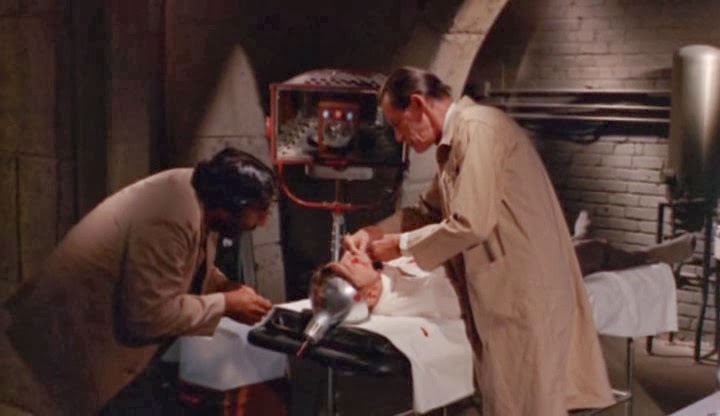
West carries on his highly questionable experimentation with Dr. Cain fully on board with the promise he can somehow bring his late love Meg back. West's nemesis Dr. Carl Hill (David Gale who begged to be part of this sequel), now a severed head, is reanimated by a rather too curious pathologist (Mel Stewart as Dr. Graves), and begins his singular mission to seek revenge. The story ticks all the b-movie boxes; an increasing implausible and insane story, eccentric characters getting more stressed and desperate, and an abundance of excessive and unnecessary blood, guts and carnage, with Coombs, the meticulous conductor always the centre of the storm. And while one can understand, and almost forgive much of the collateral damage that results from West's fight with the established scientific world, forced as he is to work on the fringe where norms just can't apply, it's harder to argue the case for someone who just wants to tie an arm to a dog or a leg and bring it to life just to see what happens, whatever the consequence. It's these scenes that solidifies West as the larger than life personality and defines Re-Animator as an exceptionally good bad-movie rather than an average to rotten bad-one.

Yuzna isn't one to shy away from a bad taste idea, however disturbing, and in Bride of Re-Animator increasingly bizarre surgical experimentation is free to come to the screen however off the wall the idea. From twitching feet, to bat wings sown to a head, to a finger and eye-ball homage to every great disembodied hand since Thing, watching for each new increasingly unfettered experimental monstrosity is as much a part of the experience as the story. Also for the most part they're all perfectly realised, given the low budget, with enough sinew and blood to cover the cracks; and though not perfect; it's eighties, it's b-movie and cracks are all part of the charm.

I'd be hard pressed to describe West's creations as zombies in any traditional or even contemporary sense. If anything these Frankenstein's meat slabs intimate of life returned; of consciousness, id, ego and will all back alongside breath and a heart-beat. It's b-movie mumbo jumbo of course; of primordial ooze extracted from the amniotic sac of the cuzco iguana and stuff about consciousness not residing in the brain but any of the tissue but the short of it West has found a way of reanimating flesh; the rest doesn't have to make much sense. There is enough ambiguity, and some of West's lesser successes, and remnants from the first film, certainly appear zombie with decay, mindless behaviour with hints of hunger and violence, and towards the end of the film appearing to be controlled by the will of another, all in good old pre-Romero Caribbean style. I'd also be hard pressed to say any of West's returnees are exactly corpus-mentis.

If I was to nit-pick, it could be argued the story is a little disjointed; more a mash-up of sub-narratives and ideas that happen to overlap rather than a grand singular story. It's also under critique rather light on substance with many of the more excessive and memorable scenes rather throwaway and unnecessary from a narrative point of view; included, the b-movie aficionado would argue for the shits and giggles, but for the cynic, perhaps to fill and because gore always sells. Still, they do fit with the insanity and as said they're really just as integral a part of the whole experience as the increasingly incredulous plot. Bride is another riotous Re-Animator chapter allowing both Coombs and the supporting ensemble to shine. With a lively, whimsical sound track and good pacing, it's perfect goofy, excessive and shocking b-movie entertainment, and this new Arrow Blu-ray release; packed with every extra you could hope for, does everything it can to bring it to life - 7/10.

Steven@WTD.

Tuesday, 22 November 2016

The Hanging Woman (The Orgy of the Dead / La Orgía de los Muertos) - review

1973 (Spain / Italy)


Contains spoilers.

I'd be lying if I said this quintessentially low budget European horror was good. I'd be equally disingenuous if I was to be overly harsh. Director José Luis Merino's La Orgía de los Muertos (translated as The Orgy of the Dead), otherwise known as Beyond the Living Dead (US),  Zombies - Terror of the Living Dead (UK), and finally and most popularly in the US, The Hanging Woman, in truth, is a distinctly mediocre gothic mad-scientist whodunnit dotted with enough distinctly brilliant and memorable moments that it almost fools you into thinking it's better than it is. The story, characters and acting is as equally laboured as It is convoluted and discordant, and despite Paul Naschy being Paul Nashy in his prime, he can't, this time, save the film entirely on his own mainly because his involvement was actually quite limited, due to parallel film commitment.

Serge Chekov (Stelvio Rosi as Stan Cooper) returning to his late uncle's estate for the reading of the will stumbles upon the grizzly scene of, whom he soon discovers to be, his niece's fresh corpse hanging from a tree. Then finding himself the, for all intents and purposes, sole benefactor he's quickly embroiled in a web of scheming and distrust, black magic and murder, in a claustrophobic and isolated backwater mansion with a cast of disparate and quite disturbed figures.

There's Igor (Paul Naschy), the crazy-eyed, dishevelled cemetery caretaker who we learn is also quite the necrophiliac and all round pervert; there's the newly widowed Countess Nadia Mihaly (Maria Pia Conte) who wants Serge to sell and is happy to persuade with sex, satanic ritual and voodoo; there's Professor Leon Driola (Gérard Tichy), the permanent guest of the late Count who specialist research is electricity and the nebulous curtain of death, and there's his daughter, the Countesses maid Doris Droila (Dyanik Zurakowska) who wants Serge to actually keep the estate for her father's sake.

At some point each and every one supplies motive and means to explain the, for at least an hour, rather sketchy, zombie murder mystery, and each and every one provides a discordant sub-narrative with Serge at the centre. And Serge loves it. Making the lead character and hero such an entitled obnoxious cad is either brave film making or suicide, as whether he's taking advantage of young vulnerable daughters or engaged in yet another innocuously provoked fist fight he's incredibly difficult to either empathise with or rally behind. Even as the credits rolled and he'd solved the case, and rescued and won the girl I couldn't help hope there would be some late twist and he'd still get the zombie maul he undisputedly deserved.

The zombies are one of the true highlights of the film and it was a pity it took such a long time to get to see them in all their splendour. Fetid, crusty and decaying, they're the epitome of the seventies walking dead infamously popularised by Fulci later in the decade. Unlike the esoteric mystical nature of Fulci's creation though, these guys have a mad Victor Frankenstein scientist and rational excuse for their reanimation. Spoiler… it was Professor Leon you see, and not any of the black magic or voodoo thrown in to put us of course. As well as learning the secrets of electrical resurrection he's also a whizz with micro-technology, designing and manufacturing a 'capsule' that slots in the corpses brain to both control its actions as well as pick up his thoughts. They're mindless drones incapable of independent thought driven solely to obey their master and the murders were all perpetrated at the behest of the prof who first wanted to kill his partner the count, to stop him using the discovery to amass 'an army of the dead'. The rest of the victims, beginning with the hanging woman, were unlucky dominoes that fell as the ever desperate Leon tried to cover his tracks. An interesting zombie twist to note at the end of the film and starting with the now resurrected Naschy, of a disobedience and demonstration of independent murderess intent, with the professor no longer able to exert control. It lead to a lively and satisfying climax, but as stated all came rather too late.

Naschy, the zombies, the sombre gothic atmosphere brilliantly captured, and the brooding organ music; there are many reasons to get excited over this early seventies continental horror. Indeed, as much as the story was long winded, trite, and discordant, and the characters generally unbearable and difficult to share any sympathy with, the constantly interspersed distractions were enjoyable despite themselves and perhaps for all the wrong reasons. Also one can't help but be charmed with echoes of a more innocent, or naive time when woman always fainted at bad news, it was ok to beat and shoot at the feet of disagreeable servants, and it was right and proper to invade and search a man's property because 'he's a strange sort and could be dangerous'. As charmed as I was though, and as much as I did enjoy the final fifteen or so minutes of zombie mayhem, I have to argue there are much better gothic horrors from this era, and this is far from Naschy's best effort. Yet, it does have a certain something that could warrant a viewing on a stormy night with curtains drawn, lights down low, and goblet of port in hand - 5/10.

Steven@WTD.

Friday, 11 November 2016

Bowery at Midnight - review

1942 (USA)


Contains spoilers.
  
Bowery at Midnight is a dark film and I'm not just referring to the multitude of night-time outdoor, and basement scenes that combined with the grainy monochrome print make it hard to discern exactly what's going on. Bowery at Midnight is a dark film with psychopaths, double lives, indiscriminate murder, and we've not even got on to the resurrection of the dead. It's also not often I make the case that I'm not entirely sure what the zombies bring to the film other than a mechanism to turn the rather bleak ending into something altogether more cheer-some for those leaving the theatre.

Bela Lugosi may have received the bulk of his fame / infamy from his portrayal of Count Dracula both on stage in the late 20's and then in its big screen namesake in 1931, and then later when Ed Wood rather infamously pulled him from his drug induced oblivion in the late 50's. During the 30s and 40s when avoiding being typecast he starred in many unique films demonstrating both his unrecognised versatility and without question his star talent. In Bowery at Midnight Lugosi plays Professor Brenner by day; an erudite confident psychology professor with doting wife and nice house. By night he assumes the role of Karl Wagner, a philanthropic soup kitchen owner, known for his unconditional kindness and no-questions policy. What his wife, students and those unfortunates he helps aren't aware of, is he's also a double crossing, jewellery robbing, sociopath who takes a huge perverse pleasure in destroying people's lives; and Lugosi is terrifyingly convincing.

Writer Gerald Schnitzer and director Wallace Fox have fashioned quite the intriguing, intelligent, coherent and yet deeply disturbing story of deception, murder and mayhem. Lugosi as Wagner uses the soup kitchen to spot vulnerable young men who might be open to highly illegal but immensely profitable night time skulduggery. Then once the deed is done, with their skills no longer required he, or his right hand man, then kill the fellow leaving him at the scene; not just as one would think, as a way of decreasing the split, but as is revealed subtly over the movie, because he enjoys it too. As he tires, or begins to distrust his lieutenant, they too are replaced and then with the blood still warm he heads home, as Brenner, to his wife (Anna Hope) with gifts and apologies for being up all night researching his next book.

While I've been rather disparaging of the zombie element of the film, taken in isolation I'm rather taken with how Fox has presented them. Dr Brooks (Lew Kelly), a written-off old quack as well as caretaker of both sides of the soup kitchen has seemingly dedicated his spare time to bringing the dead back to life. It's medicine and science and there's no voodoo or magic which is something in itself given the year it was penned. They're also a hard one to define as they're never the focus appearing only as background to the basement action scenes. They're back from the dead, so alive and not undead, but up until the final scene, which I'll come to, they do appear docile and compliant, and not exactly cognisant or the way they were before. Then there's the way Brooks keeps them locked in a room below the basement, refers to them as his pets, and when they're called upon they're unreservedly violent, tearing, metaphorically, into Wagner as the net closes in on his crime spree. The final scene I mentioned? Well to take the edge off a story where the perpetrator does finally get his just deserves, but on reflection has ruined a lot of people's lives by killing an awful lot of loved ones, Fox ends with the resurrected back as their old selves, as if nothing's happened. It's a contradictory couple of minutes I didn't much care for; totally out of place coming as it does, straight after the savage zombie beat down that really should have ended proceedings.

Bowery at Midnight is first and foremost a crime-drama, a suspense driven thriller; and a rather successful one. What it isn't is a horror, supernatural or otherwise, and it's certainly not a zombie film. If anything the resurrected victims of Brook's nefarious schemes are the one element that threatens to break the coherence, in danger of turning a truly dark, subtle, intelligent, and utterly engaging exploration of one man's detached morality, into a bit of farce. Not only is the throwaway idea of an old doctor on his own discovering a way to resurrect the dead incredulous, but more importantly, it tries to remove consequence and impact from the death and destruction graphically witnessed. Bowery at Midnight has moments that are truly evil and raw, Lugosi's performance as an over confident and out of control serial killer is remarkable, and I really don't want to see its resonance minimised for the sake of some silly resurrections and a happy ending. This all being said, and maybe because I'm conditioned to see corpses walking about, I was able to distance myself from the distractions and marvel at what the film does do right, which is an awful lot. A remarkable piece of war time cinema I'll certainly be returning to - 7/10.

Steven@WTD.

Friday, 8 November 2013

The Walking Dead (1936) - review

1936 (USA)


Contains Spoilers.

Ask me a year ago whether a frankenstein-esque film such as this had a place on my oh so precious zombie only blog and I'd have shook my head, resolutely quoting my ideological stance that zombie equals reanimated dead and definitely not resurrected and alive. Today I'm a little more relaxed, my naive dogmatic definitions shaped in the post Romero era have crumbled a little and while I still hold to notion zombies and deadness is immutable I'm a little more amenable to whether a lack of pulse is strictly necessary.

Boris Karloff plays John Ellman, a pianist and unfortunate wretch who has recently been released from a ten year stretch. Desperate for employment he becomes the unwitting patsy for a group of wealthy racketeers who see his release as the perfect opportunity to rid themselves of the troublesome Judge Shaw (Joseph King) who has become quite the thorn in their side. Hired by Trigger (Joseph Sawyer), their hit-man for hire, Ellman, who was originally convicted by Shaw, is tasked to wait outside his house and make notes on the judges coming and goings, as if a PI assistant helping establish whether he's engaged in an extramarital affair. It's the perfect set-up. Shaw's body is dumped in the back of his car along with the murder weapon, his note book makes it look like he's been stalking the judge and he has the motivatin as Shaw was responsible for his own sentence ten years earlier. As if this all wasn't enough Nolan (Ricardo Cortez), who is really working alongside the racketeers is put in charge of his defence. His death by electric chair was really quite inevitable.

It's time we mentioned Jimmy (Warren Hull) and Nancy (Marguerite Churchill), two medical assistants who happened to see everything. Despite being threatened to keep quiet they confess all and though they're too late to save Ellman, Nolan makes sure of that, there is a plan B. B stands for Dr. Evan Beaumont (Edmund Gwenn), their boss, who is researching artificial hearts and resuscitation, and because of the great injustice that now appears to have been befallen Ellman agrees with the district attorney and prison warden that it's worth a shot to see if he can be brought back to life.

Director Michael Curtiz depiction of Ellman being brought back to life is sophisticated, modern and understated. Yes there's vials bubbling and electric currents but there's no clap of thunder, hunchbacks pulling levers or screams. The reanimation sequence is clean, scientific and open; indeed Karloff himself was vocal about distancing the cinematic experience to Frankenstein which he filmed five years earlier. There's no stitching together of human pieces and Ellman comes back alive as if waking from a deep sleep to a cheque for $500,000 compensation, his picture in the paper and a guardian to help him back on his feet. So why am I reviewing this? Because the Ellman resurrected is not the Ellman who died.

He has no memories of his life before, not even his name. He can speak and understand, and he does demonstrate a new short term memory but he has no recollection of his death or, which is of particular interest to Dr. Beaumont, that period he was dead. His movements are also now sluggish and limp, and he has a crooked neck and he seems distant, like what has come back is some kind of echo and not the same full soul that departed. He's more than an echo though, and whether one interprets it religiously (there are many instances of scripture quoted), or scientifically, or something else, Ellman is now very much some kind of Ghost of Christmas Past with the knowledge and ability to directly confront all those who engineered his death.

It's a hard and strange one to interpret. There are hints of the old Ellman; he can still play piano, but what has returned, if it is Ellman at all is entirely focused on retribution. One by one he confronts each racketeer asking them "why did you have me killed?" and rather than taking the cheap and easy option portraying him as some knife wielding murderer out for revenge, Curtiz instead portrays Ellman as some untouchable innocent who holds some stark mirror up to the souls of those who caused his death. There's an 'It's a Wonderful Life / Christmas Carol' feel, and it's more subtle and more coherent. Ellman isn't a monster; he's the question, and the omnipotent knowledge and truth the murderers can't escape. Trigger falls back shooting himself, Blackstone runs away into an oncoming train, Merit has a heart attack then falls out his bedroom window; each racketeers' reaction to being confronted is different, some even try to mount an offensive first, but each of their deaths seems inevitable and self afflicted, as if Ellman is now some angel of justice obeying some grand design.

Then again he might not be. There's enough ambiguity, and divine retribution after-all is a bit old testament. He might actually be some primal damaged reflection of Ellman who has seen the infinite nothing of death and just wants to kill his enemies; I don't know. Karloff's character reminded me a little of Andy from Dead of Night (Deathdream), of someone who ought not to have returned. There also a bit of The Returned, the idea of the restless dead who aren't merely apparitions. Either way he might not be a 'ZOMBIE' in any traditional sense, but it's certainly of genre interest and he does die and is resurrected/reanimated, he does stagger towards each racketeer with a vacant look and arms outstretched, and he's definitely not who he was before with what seems like a prescribed agenda, so there's enough going on to warrant a look. Also it's called 'The Walking Dead', and that's something.

The Walking Dead is a delightful piece of cinema. It's beautifully shot with a great script, great score by Bernhard Kaun with believable sets and confident first rate acting. The story of Ellman is poignant and tragic with a beautiful ambiguity that leaves quite many unanswered questions, but no sense of being cheated. One of the best films I've seen from the 1930's The Walking Dead is a delightful, almost contemporary horror that never feels as old as it is and it's thoroughly recommended, 8/10.

Steven@WTD.

Saturday, 19 October 2013

Revenge of the Zombies (The Corpse Vanished) - review

1943 (USA)


Contains mild spoilers.

Now there's two ways of looking at this Monogram Pictures sequel to the 1941 zombie comedy King of the Zombies. The first is that it's really just another barely adequate seventy year old low budget thriller with unconvincing acting, and a hackneyed, long winded story full of all the charms of racial segregation, servitude and the perfectly acceptable misogyny that came with the times. The second is that Revenge of the Zombies is quite the uncredited gem playing more than a passing role in establishing the many of zombie tropes and idioms we now take for granted. King of the Zombies may still have had one foot firmly rooted in the Haitian voodoo zombie origin myth but there were hints of a more western scientific narrative. Revenge of the Zombies took the next logical step, shrugging off magic and the devil all together, fusing the idea and myth of the Haitian Vodou slave with Shelley's more western scientific methodology of reanimation, arguably for the first time.

Scott Warrington (Mauritz Hugo) accompanied by his friend Larry Adams (Robert Lowery) have arrived at a small retreat in the swamps near New Orleans to investigate the sudden death of his sister Lila von Altermann (Veda Ann Borg), which local family friend Dr. Harvey Keating (Barry Macollum) believes suspicious. Dr. Max Heinrich von Altermann (John Carradine) is courteous and welcomes the three men, and their servant, Jeff, the returning Mantan Moreland into his home where he shows them her body and promises a quick funeral. Behind the scenes of course he's the nefarious mad evil (albeit here it's ideological and political rather than being league with Satan) scientist, his motivations are entirely morally lacking and goal driven and it's not long before the usual cat and mouse, room to room intrigue and subterfuge with everyone showing restraint and decorum befitting those in high society when they actually all get together.

There's nothing new, it's all a bit over done and even for a just an hour long it manages to over stays its welcome. Lila disappears, Lila reappears, there's suspicion, accusation then rinse and repeat. Each actor plays their one dimensional caricatures as well as could be expected. Mantan Moreland reprieves his role from King of the Zombies as light relief breaking the scenes of serious drama with his slap stick style, quick and witty banter and contemporary, even subversive style demonstrating yet again why if he had been born a different colour he would have been an undoubted comic legend. However, what the film makes up for against the trite narrative is the occasional iconic scene and the paradigm shift in reimagining our zombie friends free of magic, hypnosis and new world influence.

Well, almost. First off, it's New Orleans, the heritage home of Vodou and the zombie but that doesn't mean magic is in the air. The zombies of Dr. Max are reanimated by science. Drugs, electricity, the idea that a body once mature retains the ability to be restarted are his methods of reanimation, the careful paralysis of parts of the human brain are those that gain him control. 'Against an army of zombies', he tells his Nazi confident, 'no armies could stand. Even blown half to bits, undaunted by fire and gas, zombies would fight on so long as the brain cells' that receive and execute commands, still remained intact.' Writer Edmond Kelso, allowed to continue to expand his ideas from King of the Zombies might well be responsible for establishing quite the set of zombie staples.

The zombies of director Steve Sekely's film might well be impervious reanimated machines built for fighting but they're still very firmly slaves under the control of a master. There's no flesh eating or rabid primal driving, they're workers able to reply to orders and perform all manner of rudimentary tasks implying their memories and cognitive abilities are still very much intact. There's also the indication that full self-aware reanimation would actually be possible with Lila seemingly able to retain some of her will and even the ability to 'turn' Max's army of zombies back onto him. The narrative for this control is still quite confusing and incoherent and it's never explained why the zombies were able to return to their eternal slumber once their master was killed but it did lend itself for quite the atmospheric final scene in the same graveyard that was saw the dead rise at the start, this time close the crypt's door.

Credit must be given for breaking the given notion that zombies are inexorably tied to voodoo and magic, hinting at a more western and contemporary approach to thinking about the walking dead in terms of chemicals and science and atmospherically it does a lot right but ultimately Revenge of the Zombies can't shrug off its dismal cliché story, shallow characterisation and pedestrian acting. A low budget war time film it's not bad per-se and Mantan Moreland does shine, but this undoubted piece of important zombie cinema is denied any real esteem by just being a bit too ordinary, 4/10.

Steven@WTD.

Tuesday, 15 October 2013

Frankenstein's Army - review

2013 (Netherlands / USA / Czech Republic)


Contains mild spoilers.

So two reviews in two that are for releases of the same month; I could kid myself I'm getting relevant and with the times, but I'm sure its just coincidence and I think after being so recently taken by the Nazi Zombie madness that was Outpost I was really just after more of the same.

Director and co-writer Richard Raaphorst's Frankenstein's Army is a riotous insight into the mind of quite the depraved visionary. It's dark, perverse and deeply disturbing, and the descent for Novikov (Robert Gwilym) and his unruly band of degenerate Soviet scouts into Frankenstein's lair is truly the stuff of nightmares. I loved it.

Viktor Frankenstein (Karel Roden) is the grandson of the same Victor Frankenstein Mary Shelley penned back in 1818. Released from a mental institute by an ever desperate Nazi regime facing onslaught from two fronts he has been given resources and moral exoneration to expand on his and his grandfathers ideas to create an army of super soldiers that could put a stop to their inevitable defeat. The band of Soviet scouts that stumble into the hive are the usual ragtag assortment of ne'er-do-wells, innocents and beleaguered, and their exploration the usual tailspin from cocky to utterly fucked as their numbers start to plummet. 

WW2, Nazi occult, scientific, cyborg, morally repugnant experimentation; it's nothing we haven't seen before with each new iteration trying to out-do the one before with ever increasing depictions of cruelty and depravity. What stands Frankenstein's Army out from the crowd is the sheer lengths it's willing to go to become the new crowned king of in your face sick and repugnant and its use of 'reel' first person camera footage to capture the carnage, a la [REC] and Blair Witch.

I was in two minds, very much like how Sergie (Joshua Sasse) ends up under Viktors knife, as to whether to look at this as zombie film. Though my definition of zombie has gone through quite the period of reflection and relaxation this last year, I'm still pretty adamant that the synonymous Frankenstein's monster as penned by Shelley still doesn't quite fit the bill. While reanimation, slow ponderous movement, confused state and moral ambiguity are all obvious genre influences, it's the drive of the monster to always become the resurrected human he once was, that's the rub. I'm less concerned these days whether a zombie's deadness should be reduced to having a pulse or not; what interests me is whether there's still will, super-ego and ability to be autonomous and as is the case with the macabre monstrosities of Frankenstein's Army, whether they're entirely subservient to a master who has stripped them of all their self-defining facets. Viktor does reanimate them back to life with electricity and he does have to feed them once they're back on their feet but the people they once were are gone; there's no search for bringing back life, it's about the creation of robots, slaves and unquestioning killers, and in my mind this fits with zombies type.

It goes without saying they're also pretty twisted and unnaturally unpleasant to watch; and not that dissimilar in style from the nightmare creations in Clive Barker's Hellraiser. Viktor is indiscriminate whether the material for his bizarre flesh and steel fusion comes dug up, is recently deceased or even comes shrink-wrapped and alive and screaming. He's also quite the Henry Ford of monster making as once into his elaborate factory of recycling, r&d and manufacturing, conveyor belts of body parts are stitched and fused into quite the breathtaking original and elaborate array of creations by a workforce of equally unnatural zombie slaves. There's a definite anything goes approach to Raaphorst's freakish mis-creations, and wondering what he'll have come up with next is very much one of the highlights of the film. Such is the ludicrousness and excessiveness though that in some ways it does loose a little of the overwhelming fear that you feel should be there. In many ways I felt it all too quickly turned a bit comic book / video game-y as the first person camera ducked and weaved away from one bulking knife-wielding, propeller-spinning or jaw-snapping brute after another. It's a film more than many that calls for a high suspension of disbelief, as peeking behind the veil, which I did on more than one occasion, and seeing the terrifying monstrosities for what they were, quite excessive and daft prosthetic costumes, can be quite off-putting. It never turns into a full on farce though, but at times it falls precariously close.

Frankenstein's Army is quite a stupid film with a very simple premise and story, but with critical thinking firmly disengaged it's quite the thrilling dark and unsettling experience. The soldiers descent into madness is coherently defined and paced, and Raaphorst certainly knows how to use sound, effects and the first person viewpoint to create quite the evocative heart racing chase scene (which there are many). The first person perspective almost avoids the pitfalls that come with the territory providing quite a reasonable narrative reason for Dimitri (Alexander Mercury) to not stop filming when the proverbial shit (well blood) is hitting the actual spinning blades, but inevitably it can't dodge them altogether. Frankenstein's Army could be nit picked to death, and maybe I'm getting soft, but I couldn't help but respect and enjoy it for being quite as audaciously excessive and ridiculous as it was. Gory, bloody, in-your-face-nasty but not quite as scary as it wants to be, 7/10.

Steven@WTD.

Wednesday, 25 September 2013

The Astro-Zombies - review

1968 (USA)


Contains spoilers.

Twenty minutes into The Astro-Zombies as I sat patiently watching Dr DeMarco (John Carradine) the films Dr Frankenstein painstakingly remove three screws from a small metal box, drop in a small bit of a circuit board then screw them up again, only for the action to then move ponderously to his deformed Igor, Franchot (William Bagdad) who was crouching waiting for a switch to be flipped so we could watch his large bucket of blood dribble full I realised that I really do hope your guys and gals appreciate what I'm putting myself through on your behalf. That scene alone took about five minutes though it felt much longer, and that's the rub with The Astro-Zombies; it's just so damn ponderous and laboured.

I love a good-bad zombie film, and must even get some kind of masochistic pleasure from bad-bad ones as for all its problems, and there's a hell of a lot, Ted V. Mikels 60s exploitative space, pseudo scientific mumbo-jumbo spy thriller isn't actually all bad, though not for the reasons you'd think. It's not the wooden acting, the appalling masks and prosthetics, or the implausibly incoherent narrative or kitchen sink approach to content that pulls it down. Ironically it's the fact there's too much trying to present the ludicrously ridiculous as plausible and coherent, too much sincere explanation and a good thirty minutes of fluff that could easily have been cut or heavily edited out.

The story is pure b-movie super-cheese. The CIA, lead by Holman (Wendell Corey) are investigating a series of grizzly mutations suspecting it might have something to do with the missing Dr DeMarco who before he was dismissed from 'the space agency' had been working on an idea to put reanimated memory-and-will-sapped cadavers in space with solar powered hearts, disease free blood and thought wave transmission circuitry so that they could be operated from earth telepathically by highly skilled operators. Yeah. It's a bold idea and if I was the CIA I'd probably be keeping an eye out on him too.

They're not the only ones after him though. Not content for the film to be CIA vs the mad scientist and his zombies, Mikels deemed it necessary to add a third party to spice it all up and turn it into a bit of cold war spy thriller. The KGB have decided they want in on zombie space men so they've sent a crack team (I say crack team, I mean thug and camp sadist) lead by femme fatale Satana (Tura Satana) to acquire the research first by any means possible.

What we end up with a confusing tale, not helped with overly complicating editing. The CIA stumble about, the KGB stumble about, the rogue astro-zombie, or quasi-man, as they put it, stumbles about; there's a bit of espionage, a lot of 60s drinking and misogyny, a few shootings, lots of fringe-science / star trek-esque science-fiction that's over explained and even a few minutes of totally unnecessary topless go-go dancing from a painted girl to a Haitian Latin bongo beat. It's pure b-movie z-grade nonsense with hammy dialogue, poor effects and bad direction, but it did on occasion tickle my fancy so to speak. If we're honest we expected all this though; it is 1968 and the bizarre obviously fake prosthetic skulls, break away shots to blood spattered walls or silhouette whenever there's an amateur zombie fumble all attest the fact it's a shoe-string amateur production, obviously well intentioned but entirely lacking the ability to pull it altogether intelligently or cohesively.

The zombies are actually quite interesting all things considered. They're fresh cadavers, they've somehow and let's not get into it, had their emotions and memories removed to turn them into, as DeMarco puts it, pure calculating machines then they're given artificial hearts, organ transplants, a thought wave FM radio mind controller and then brought back to life. In many respects they're the perfect meeting point for the old Haitian voodoo zombies and the dead Romero-esque modern killers. They're automatons and slaves but they retain a murdering instinct and can go out of control. The rogue quasi-man is actually a rogue; he's bad, he's (with sinister music) dun dun dun, a criminal, and that's actually why he's gone off on his murderous rampage. You see, he may have been asset stripped of all that made him who he was but here central morality is all nature (not nurture). If you're a bad egg, you're a bad egg and you probably shouldn't be reborn with insatiable brutality, super strength and the ability to shake off being shot. Physically they entirely human in movement and even keep on their funeral suit; all that's different is the ridiculous head gear and all the cyborg circuitry.

The Astro-Zombie really is a clumsy cheap b-movie rehash of the Frankenstein story albeit spun as a poor early star trek episode allowed to be a bit gory and a bit less plausible. You've got to understand what you're getting yourself into with a movie like this though; it's right up there with Plan 9 and some of the worst movies ever made, with preposterous scripts and baffling audacity and ambition, especially given the lack of money and talent. The thing is, knowing all this, and going in expecting to be it all one can actually have a good time, and the absurdity becomes compelling. The Astro-Zombies is what is; the pinnacle of bad b-movie sci-fi horror film making with no redeeming quality other than having no redeeming quality. Great cheesy rubbish, 3/10.

The picture quality for such a b-movie was for the most part pretty good though there was the occasional scene or set of scenes with a lot of noise or sudden reduction in resolution. Sound was good if soft but I had no real problems with the disc. Some extras would have been nice though.

Steven@WTD.

Monday, 9 September 2013

Re-Animator - review

1985 (USA)

2002 Elite Entertainment Millennium Edition DVD R(1)

Contains spoilers.

I'll be honest, I'd never really considered this a film I'd be covering when I started the blog, thinking my time would be spent watching post-apocalyptic survival stories or tempered black and white voodoo tales from the new world. The name, the cover and what I presumed I knew all pointed to the Frankenstein's Monster myth and something I'd always considered outside my remit. I recently put my thoughts down, cementing a position that a corpse brought back to life isn't the same a corpse reanimated but still very definitely dead. There was a problem though, unlike any of the dozen or so Frankenstein retellings I kept seeing Re-Animator on best zombie film lists. There's the name too, Re-Animator implies reanimation and not necessarily bringing back to life.

So here we are. First off I'm a lucky boy as it's not often one gets the chance to watch a firm cult favourite for the first time, finding yourself thoroughly in agreement with all the praise and plaudits it's received. However, the way in which the film plays with, and challenges the defintion and absoluteness of what it is to be alive or dead, it's thrown a huge proverbial spanner into my what-is-a-zombie-and-what-isn't dogmas, just as I thought I was getting a handle on it all too.

Jeffrey Combs is Herbert West, a young brilliant but misguided medical student who has come to  Miskatonic University in New England, from the University of Zurich, Switzerland to further his research into resuscitating the dead. Armed with a luminous green resurrection goo Herbert believes is the key to resurrection and immortality he wins over his house mate Dan Cain (Bruce Abbott), persuading him such is the importance of this discovery he should throw ethics and common-sense out the window and help him with his last few field trials.

It's goofy, stupid;  and from the start the perfect 80s camp horror comedy full of gratuitous gore and outlandish ideas. West aided by Dan does succeed in raising the dead, but it doesn't go without a hitch, and in trying to fix their mistakes the pair only make things worse. It's perfect train-wreak cinema; watching an inevitable chain reaction of events leading to carnage and chaos. Director Stuart Gordon has paced it all to perfection with the onscreen lunacy and action increasing by orders of magnitude to a truly spectacular explosive conclusion.

So Herbert West has brought them back to life right, so they're not zombies? It's not so simple. The brain, West's new teacher, Dr. Carl Hill (David Gale) tells him, can only last for between 6 and 12 minutes after death before it's irreparably lost, and it's this idea that dictates the behaviour of those brought back, and also has caused me to question what I consider dead when it comes to the modern zombie.

I've reiterated recenty my new respect that the concept of zombie is ambiguous, changeable and contains more wiggle room than I'd previously entertained. West's reanimated have been dead, but are now upright and breathing. They're alive but they're brains are all but completely destroyed leaving them only primal instincts and the ability to respond to rudimentary sensory stimuli. Even Dr. Hill confronting West over the state of Dean Alan Halsey (Robert Sampson), an early accidental casualty of West's mishandling and over exuberance, proclaims they both know the now shambling, groaning shell of man is clearly 'dead' in all but name.

One thing I was steadfast in though was my belief a zombie should, phenomenally putting it, embody a little deadness. While I've been guilty of previously of reducing this to lack of pulse and heart-beat as well as absence of consciousness and conscience perhaps I need to think bigger as these reanimated cadavers clearly embody zombie; albeit with a little blood flow.

Anyway, further through the film West successfully reanimates detached body parts, the whole film tumbles into the absurd and all these points kind of become moot. Heads and bodies clearly can't be 'alive' in any real medical sense but here they are quite animated and independent, yet possessing some 'fanciful' ability to still interact. At this point it's no longer worth the pseudo linguistic philosophical torture and I'm happy to hold my hands up and get with the japery and carnage.

I've rambled on at length but not really mentioned the film. The narrative may be daft and eccentric but the film is coherent, cohesive and another perfectly pitched horror comedy in the vein of Evil Dead II or Dead Alive. The laughs come from the absurdity of the action rather than overt jokes and the consummate deadpan; dead straight acting from all involved elevates what could easily have been quite the b-movie into something that feels both grand and competent. The effects and gore are constantly superb with some truly memorable and totally disgusting sequences that will stay with me forever. The reanimated actors are some of the best and if an award was to be given for best naked zombie fight this would win hands down.

There's a simple reason some films attain cult status and spawn a host of sequels and pretenders; it's because they're that good. A captivating, audacious over the top cinematic experience full of memorable scenes and dialogue, and responsible for me having to think a little harder about what is or isn't a zombie, 9/10.

As the Blu-ray release is R(A/1) locked I reviewed the unrated Millennium DVD edition which is 9 minutes longer than the theatrical release and seems to be the most complete.

WTD.